
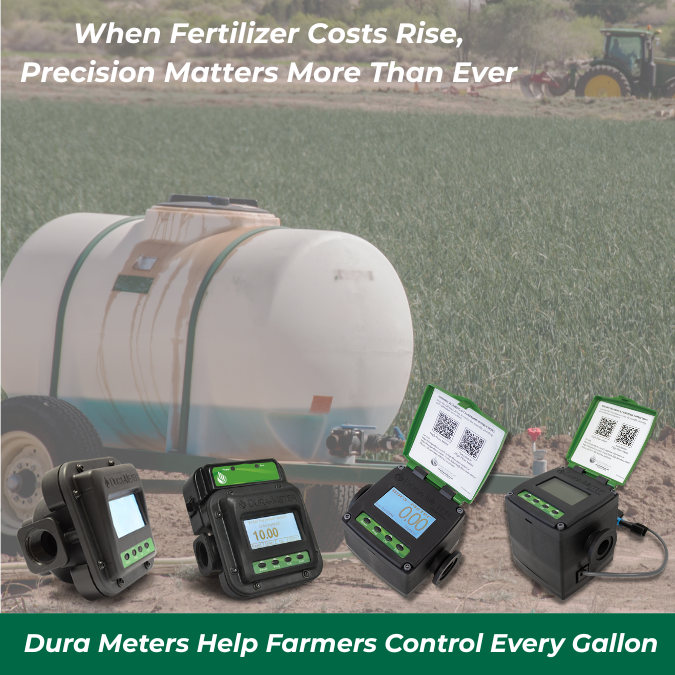
Fertilizer and crop protection products represent some of the largest input costs on modern farms. When these costs increase, growers and applicators naturally look for ways to improve efficiency and ensure every gallon of product is used effectively.
One of the most important operational shifts that happens during periods of high fertilizer prices is a stronger focus on measuring and controlling liquid inputs.
This is where accurate flow metering systems play a critical role.
The Growing Need for Precise Fertilizer Measurement
Many fertilizer transfer and fertigation systems still rely on visual estimates or tank markings to determine how much product is being moved or applied. Unfortunately, these methods are often inaccurate due to poor calibration, uneven surfaces, or limited resolution on tank markings.
See article by Michael Cahn in Progressive Crop Consultant here.
Without accurate measurement, operators can unknowingly:
- Over-apply costly fertilizer
- Under-apply nutrients needed for crop performance
- Lose track of total product usage across fields
Flow meters solve this challenge by directly measuring the volume of liquid fertilizer moving through the system, giving operators real-time data they can rely on.
What Research Shows About Flow Meter Accuracy
Researchers from the University of California Cooperative Extension evaluated several flow meters commonly used to measure liquid fertilizer, including the Banjo FM100, Dura-Meter, and Blue-White F-1000.
The study tested these meters using water and common fertilizer solutions such as ammonium nitrate (AN20) and urea-ammonium nitrate (UAN32).
Results showed that all three meters were generally accurate, with errors typically within ±2% of the actual volume measured.
However, the evaluation found that the Dura-Meter delivered the highest overall accuracy, with:
- An average error of –0.2 gallons per 25 gallons measured
- A very low variation between repeated tests (±0.3% coefficient of variation)
The research noted that the Dura-Meter’s nutating disk measurement design directly measures liquid volume, which helps maintain accuracy even when fertilizer density changes.
See the full article by Michael D Cahn here.
Why Accurate Metering Matters When Inputs Are Expensive
As fertilizer costs rise, farms increasingly adopt practices that emphasize precision agriculture and resource efficiency. Precision technologies help optimize nutrient use, reduce waste, and improve overall productivity.
Accurate flow measurement supports these goals in several ways.
1. Better Control of Fertilizer Applications
Flow meters allow operators to measure the exact amount of fertilizer transferred into nurse tanks, sprayers, or irrigation systems. The Auto-Batch™ High-Flow Meter System can be controlled with the Dura Remote Bluetooth® wireless app.
3. Reduced Waste and Input Costs
By eliminating guesswork, accurate metering helps prevent over-application and unnecessary product loss.
4. Support for Precision Agriculture
Flow meters are an important component of modern precision systems that aim to optimize nutrient use and increase efficiency.
How Dura Meters Help Farmers Control Every Gallon
Dura Products designs flow meters specifically for agricultural fluid handling applications. These systems help operators measure, transfer, and manage expensive inputs with confidence.
Dura metering solutions provide:
- Accurate measurement of fertilizers and crop chemicals
- Durable designs built for agricultural environments
- High-flow capability for nurse trailers and transfer systems
- Compatibility with batching and automated systems
Dura’s lineup includes solutions such as the Dura-Meter™,Auto-Batch™ Meter, High-Flow Dura Meterand Auto-Batch™ High-Flow Meter, all designed to enhance the efficiency and accuracy of liquid transfer operations.